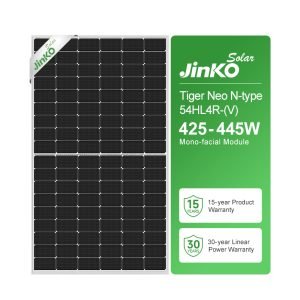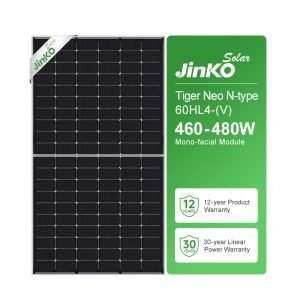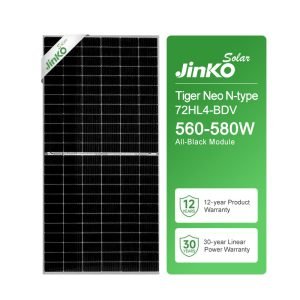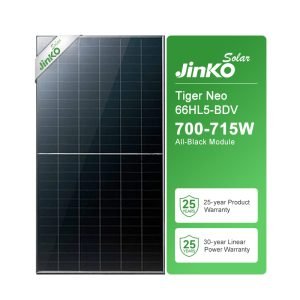
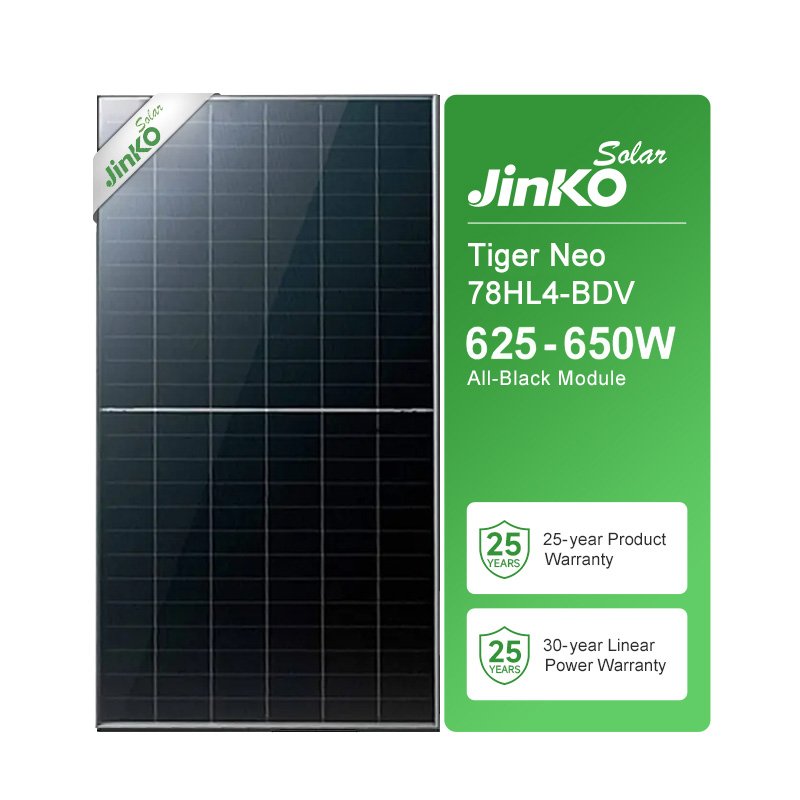
The Jinko solar panel Tiger Neo 78HL4-BDV series (625W, 630W, 635W, 640W, 645W, 650W) is a high-power N-type TOPCon bifacial dual glass module built for utility-scale power plants and large commercial & industrial (C&I) projects. As an authorized Jinko solar panel China agent, we offer factory-direct pricing, fast global export service and full technical support. Contact us today for a free quotation.
Jinko Solar Panel Key Features
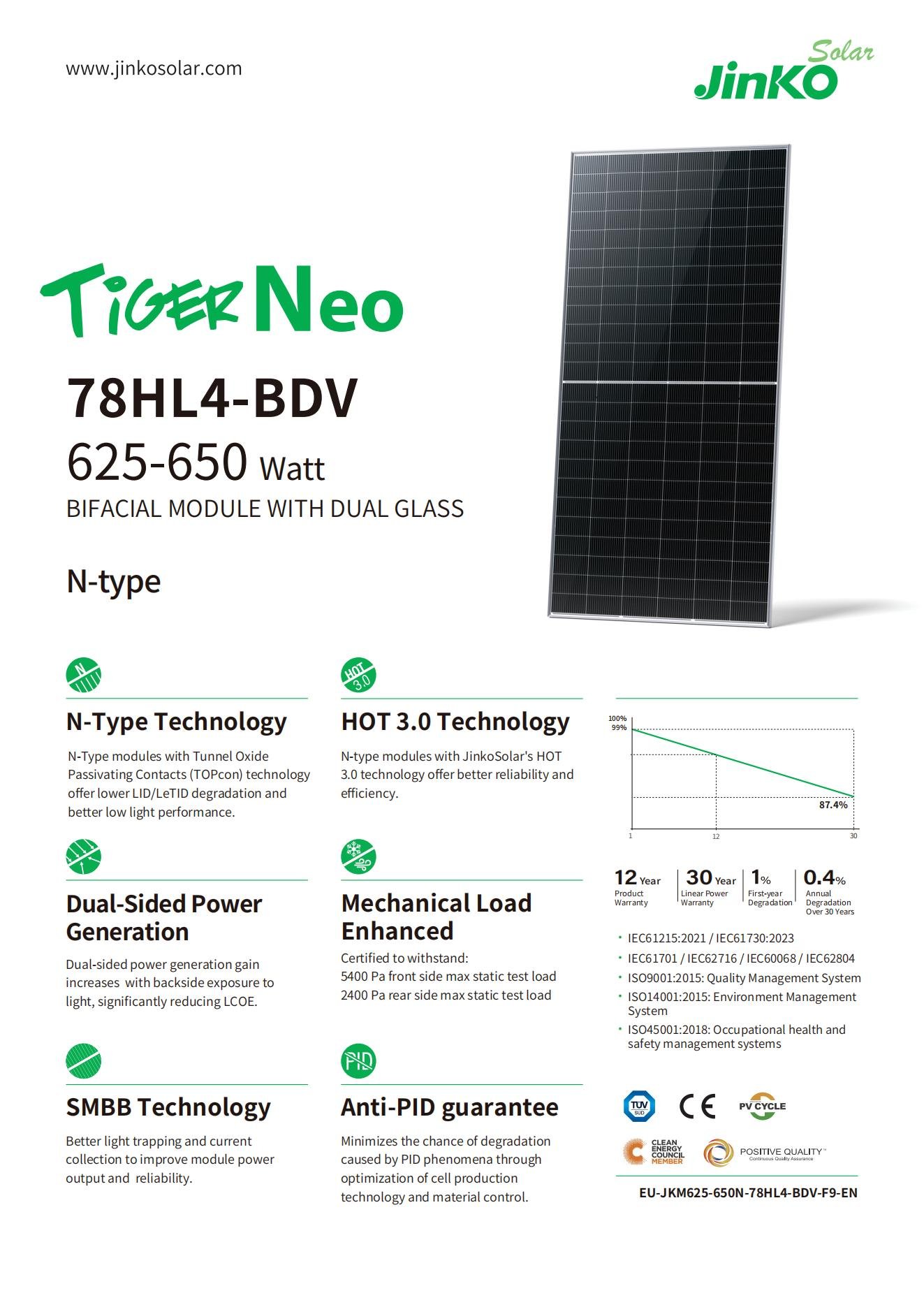
- N-type TOPCon cell technology – higher efficiency, lower first-year degradation and better weak-light performance than conventional P-type PERC modules.
- Bifacial dual glass design – the rear side captures reflected and diffused light, delivering up to 25% additional energy yield depending on ground albedo.
- High power output – 625–650W per module with efficiency up to 23.3%, reducing balance-of-system costs and land usage.
- 156 half-cut cells with multi-busbar design – lower resistive losses and better current collection under real-world conditions.
- Dual glass durability – 2.0mm heat strengthened glass on both sides for superior fire rating, PID resistance and lower annual degradation.
- Certified environmental resistance – resistant to salt mist and ammonia, suitable for coastal and agricultural installations.
Jinko Solar Panel Specifications
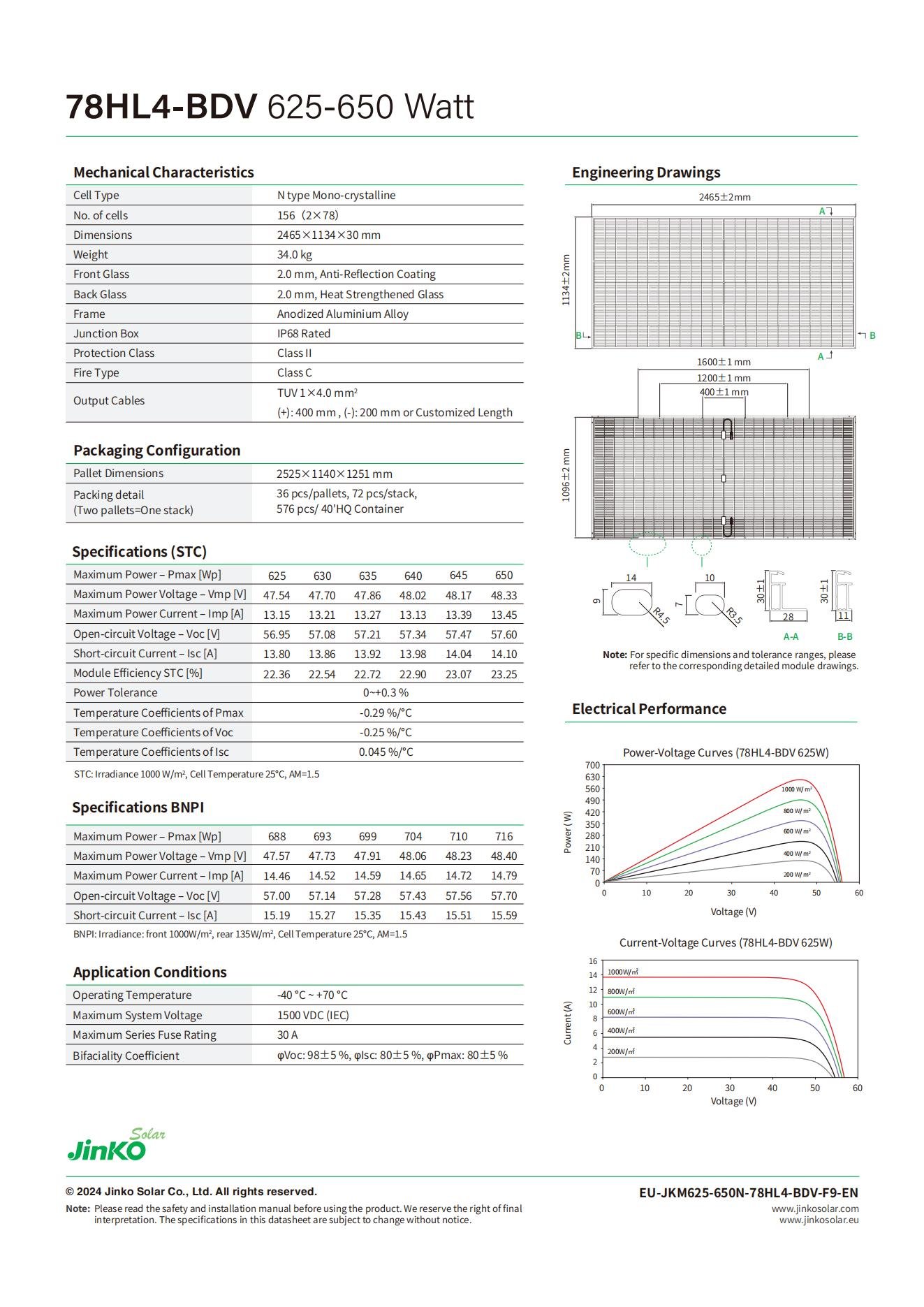
| Module Number | Tiger Neo 78HL4-BDV (625W–650W) |
| Cell Type | N-type Mono-crystalline (TOPCon) |
| No. of Cells | 156 (2 x 78) |
| Dimensions | 2465 x 1134 x 30 mm |
| Weight | 34.0 kg |
| Front Glass | 2.0 mm, anti-reflection coating, heat strengthened glass |
| Back Glass | 2.0 mm, heat strengthened glass |
| Frame | Anodized aluminium alloy |
| Junction Box | IP68 rated |
| Protection Class | Class II |
| Fire Rating | Class C |
| Output Cables | TUV 1 x 4.0 mm², (+) 400 mm / (−) 200 mm, or customized length |
| Packaging | 36 pcs per pallet, 576 pcs per 40′ HQ container |

N-type TOPCon Technology Inside This Jinko Solar Panel
The Tiger Neo series is built on Jinko’s N-type TOPCon cell platform. Compared with conventional P-type PERC cells, TOPCon cells add an ultra-thin tunnel oxide layer and a doped polysilicon layer on the rear side, which significantly reduces electron recombination losses.
The result is higher conversion efficiency, lower first-year degradation and a slower annual degradation rate. Over a 30-year project lifetime, a Jinko solar panel with N-type TOPCon cells can generate noticeably more cumulative energy than a comparable PERC module.
N-type cells also suffer no light-induced degradation (LID) and very low light-elevated temperature degradation (LeTID). This makes the Tiger Neo series a safer long-term investment for project owners, EPCs and investors who bank on stable energy yields.
Bifacial Gain Explained
The 78HL4-BDV is a bifacial dual glass module, meaning its rear side also generates electricity from reflected and diffused light. Depending on ground albedo, mounting height and row spacing, bifacial gain typically adds 5% to 25% extra energy yield.
Light-colored ground covers, white gravel, sand or reflective membranes maximize rear-side production. Our engineers can estimate the expected bifacial gain for your specific site conditions before you order this Jinko solar panel series.
Jinko Solar Panel Gallery
Recommended Applications
With 625–650W per module and a large 2465 x 1134 mm format, this Jinko solar panel series is optimized for ground-mounted utility power stations, solar farms and large flat commercial rooftops. The high wattage reduces the number of modules, strings, racks and cables required per megawatt.
For agricultural and coastal projects, the certified resistance to ammonia and salt mist ensures stable operation in corrosive environments. The bifacial design performs especially well over reflective ground such as sand, snow or white membranes.
For small residential rooftops, we recommend more compact Jinko solar panel models with lower wattage and smaller dimensions, which are easier to handle and arrange on limited roof areas.
Why Buy from a Jinko Solar Panel China Agent?
As a China agent for Tier-1 brands, we source Jinko solar panels directly through authorized factory channels, so every module is genuine with complete serial-number traceability. You get manufacturer warranty coverage without paying trader markups.
Working with a China agent also means competitive wholesale pricing per watt, flexible minimum order quantities and fast container loading. Our export team handles documentation, customs clearance support and shipping insurance for every order.
Mixed loading is supported as well: you can combine this Tiger Neo series with other modules from our solar PV product catalog in a single container to optimize freight costs.
Browse the complete range in our Jinko solar panel category, or download datasheets and certificates from our download center. For official corporate information, visit the Jinko Solar official website.
Export Service & Global Delivery
We export Jinko solar panels to most countries in Asia, Europe, Africa, the Middle East and Latin America. Sea freight, railway freight and multimodal transport can all be arranged according to your timeline and budget.
Standard export documentation includes the commercial invoice, packing list, bill of lading, certificate of origin and product certificates. Our team prepares everything your customs broker needs for smooth clearance at the destination port.
For urgent projects, ask us about ready stock in China warehouses. Selected Jinko solar panel models are available for fast dispatch, shortening the total lead time by several weeks compared with factory production orders.
Warranty & Certifications
Every Jinko solar panel in the Tiger Neo bifacial series is covered by the manufacturer’s product workmanship warranty and a 30-year linear power output warranty for dual glass modules (please refer to the official Jinko Solar warranty documents for exact terms by region).
The modules are certified to IEC 61215 and IEC 61730 standards and carry TÜV, CE, UL and other regional certifications. We can provide copies of certificates, test reports and factory inspection reports on request to support project financing and due diligence.
How to Choose the Right Wattage
All six wattage classes of this Jinko solar panel series share the same dimensions, weight and mechanical design. Higher-wattage versions deliver more power per module, which lowers installation cost per watt and reduces the total module count.
If your inverter or tracker design is already fixed, our engineers can simulate string configurations for 625W, 630W, 635W, 640W, 645W and 650W versions and recommend the option with the best energy yield and lowest system cost.
Quality Control & Factory Testing
Every Jinko solar panel passes through automated EL testing, visual inspection and flash testing before packing. Micro-cracks, soldering defects and power deviations are screened out at the factory.
We can share flash test reports and EL images for your specific batch before shipment. Third-party inspection by SGS, TÜV or BV can also be arranged at buyer’s request for additional peace of mind.
Common Mistakes When Importing Solar Panels
Many first-time importers focus only on the lowest price per watt. In practice, inconsistent batches, missing certificates and unclear warranty terms cost far more than a small price difference. Always confirm that modules come through an authorized Jinko solar panel China agent with traceable serial numbers.
Another common mistake is ordering without checking local certification requirements. Some markets require specific listings or local test reports; confirm these details with our export team before production to avoid customs delays.
Market Trends: Why N-type Bifacial Is the New Standard
The global PV industry is shifting rapidly from P-type PERC to N-type TOPCon technology. Bifacial N-type modules like this Jinko solar panel Tiger Neo series offer higher efficiency, lower degradation and extra rear-side energy for the same footprint.
For buyers planning projects with 25–30 year lifetimes, choosing N-type bifacial today protects your project from early technology obsolescence and improves long-term returns.
Storage & Handling Guidelines
Before installation, store pallets indoors or under a waterproof cover on flat ground. Do not stack pallets unless the packaging is designed for stacking, and keep modules away from standing water and corrosive chemicals.
When unpacking, lift modules by the frame with two people and never step on the glass surface. Following these simple rules protects your Jinko solar panel investment from avoidable micro-cracks and scratches before commissioning.
Ordering Process
Ordering Jinko solar panels from us is straightforward. First, send your project details and target quantity. Second, receive a formal quotation with datasheets and certificates. Third, confirm the contract and arrange the deposit. Fourth, we schedule production and share inspection reports before shipment. Finally, we book freight and send all export documents for customs clearance at your port.
About Our Company
We are a professional photovoltaic modules manufacturer, China agent and energy storage solutions provider based in China, exporting Tier-1 brand modules to distributors, EPCs and project developers worldwide. Our team has years of experience in export documentation, project logistics and technical support.
Jinko Solar Panel FAQ
What is the Jinko solar panel price for the Tiger Neo 78HL4-BDV?
The Jinko solar panel price depends on wattage, order quantity and destination port. As a China agent with factory-direct channels, we quote very competitive wholesale prices. Send your project details through our contact page and we will reply within 24 hours.
Do you export Jinko solar panels to my country?
We export to most countries in Asia, Europe, Africa, the Middle East and Latin America. Tell us your destination port and we will confirm freight options, transit time and any local certification requirements.
What is the minimum order quantity?
We accept orders starting from one pallet (36 pcs). Sample orders for testing and certification purposes can also be arranged on request.
How much extra energy does the bifacial rear side add?
Depending on ground albedo, mounting height and row spacing, bifacial gain typically ranges from 5% to 25%. Light-colored or reflective surfaces maximize the benefit.
How do I verify the modules are genuine?
Each Jinko solar panel carries a unique serial number and barcode label. You can verify authenticity through official Jinko Solar channels, and we provide factory documentation matching every serial number in your shipment.
What payment terms do you accept?
We accept T/T, L/C at sight and other negotiable terms for qualified buyers. For new customers, a deposit with balance before shipment is the standard arrangement.
How long is the production lead time?
Lead time depends on order quantity and the factory schedule. Standard production typically takes two to four weeks after deposit confirmation, plus shipping time to your port. Ready-stock models ship faster.
Can I mix different wattages in one container?
Yes, mixed loading of 625W to 650W versions in one container is supported. This is useful when different ground areas require different string lengths.
Can the cable length be customized?
Yes. Standard cable length is (+) 400 mm / (−) 200 mm, and customized lengths are available for orders meeting the minimum quantity, which is useful for tracker layouts and special row spacing.
Do you offer after-sales support?
Yes. Our team assists with installation questions, warranty claims and replacement coordination. For large projects, remote technical support during commissioning can be arranged.
Electrical Performance & Low-Light Behavior
This Jinko solar panel uses half-cut N-type TOPCon cells with a multi-busbar layout, which shortens the current path inside each cell and reduces resistive losses. Under weak morning or evening light, the module starts producing earlier and keeps generating later than many conventional modules.
The low temperature coefficient of the Tiger Neo series also protects output during hot summer afternoons. For project owners, this means a higher and more predictable energy yield across all seasons, which directly improves project cash flow.
Typical Project Scenarios
Utility-scale solar farms: the high wattage, bifacial gain and low degradation of this Jinko solar panel series maximize energy output per hectare and minimize the number of strings, trackers and inverters required.
Commercial rooftops: factories and warehouses with large flat roofs benefit from fewer modules per megawatt, which shortens installation time and reduces roof loading points.
Agrivoltaics and carports: the certified ammonia resistance and elevated mounting of these structures let the bifacial rear side capture extra reflected light from the ground below.
Project Support & OEM Services
Beyond supplying modules, we support EPCs and distributors with system design advice, string sizing, and documentation for tenders. For large framework agreements, OEM labeling and customized packaging are available.
Distributors partnering with us get priority access to new Jinko solar panel product launches, marketing materials and technical training for their sales teams.
Sustainability & Recycling
Jinko Solar operates a global module recycling program and designs products for a service life of 30 years or more. Choosing a durable N-type dual glass module reduces waste per kilowatt-hour generated over the project lifetime.
Glossary of Key Terms
TOPCon stands for Tunnel Oxide Passivated Contact, an N-type cell technology that reduces electron recombination and boosts efficiency. Bifacial gain is the extra energy produced by the rear side of a dual glass module. LCOE means Levelized Cost of Electricity, the lifetime cost per kilowatt-hour of a power plant. PID is Potential Induced Degradation, a power loss mechanism that this Jinko solar panel is certified to resist.
Which certificates can you provide with the modules?
We provide IEC 61215, IEC 61730, CE, TÜV and other certificates depending on your market. Copies of test reports and the warranty document are shared before shipment, and originals can be couriered with the shipping documents.
Can you help with system design for my project?
Yes. Share your site coordinates, roof drawings or land survey, and our engineers will prepare a preliminary module layout, string sizing and estimated energy yield report free of charge for serious project inquiries.
What is the HS code for these modules?
Solar modules are generally classified under HS code 8541.43. Import duty rates vary by country; our export team can share the documentation needed for your customs broker to confirm the exact rate.
Do you support small trial orders?
Our main business is wholesale and project supply, but trial pallet orders are welcome for new distributors who want to test the market before committing to container quantities.
What documents come with the export shipment?
Standard export documents include the commercial invoice, packing list, bill of lading, certificate of origin and product certificates. Additional documents for tenders, financing or local grid approval can be prepared on request.
Can the cable length be customized for tracker projects?
Yes. Standard cable length is (+) 400 mm / (−) 200 mm, and customized lengths are available for orders meeting the minimum quantity. Custom cables reduce on-site wiring work for tracker layouts and special row spacing.
Why do professionals choose Jinko solar panels for large projects?
Bankability is the key reason: Tier-1 status, stable financials and decades of field data make it easier to secure project financing. Combined with N-type TOPCon performance and bifacial gain, this Jinko solar panel series is a safe long-term choice for investors and EPCs alike.
How fast can you ship from China stock?
For ready-stock Jinko solar panel models, dispatch from our China warehouse usually takes one to two weeks after order confirmation, including export customs clearance. Production orders take two to four weeks plus ocean freight. Tell us your project deadline and we will recommend the fastest supply option.
Ready to order your Jinko solar panels? Request a free quote today and our engineers will help you select the right wattage and configuration for your project.